
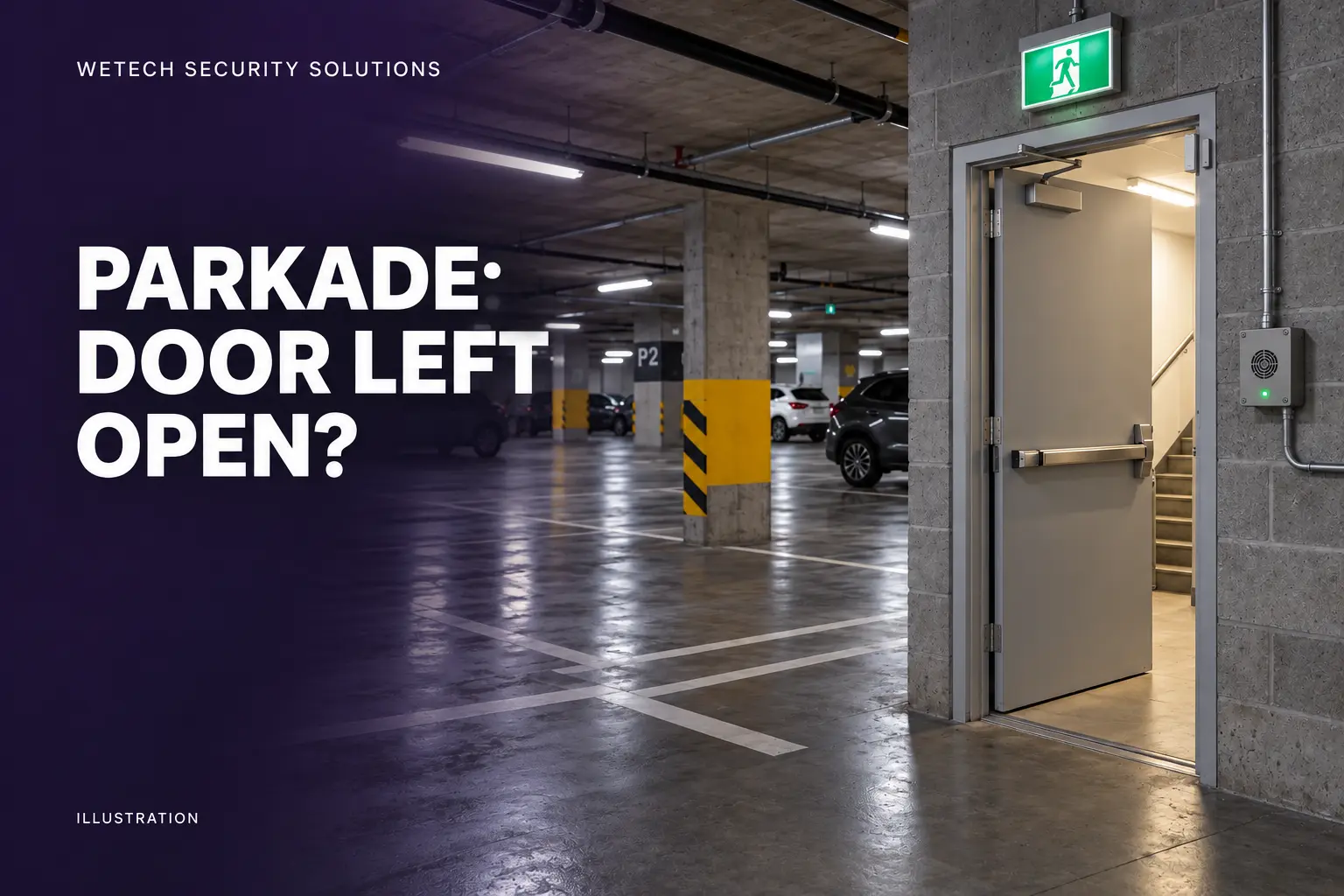
A Vancouver strata parkade can have a controlled vehicle gate, managed fobs and CCTV, yet one pedestrian exit left propped open can create an uncontrolled route back into the property. That is why a complete parkade-security review follows pedestrian doors as well as the vehicle entrance.
The practical response is not automatically another camera or an alarm that sounds every time the door moves. It is a system designed around the exact door condition the building needs to detect, the warning it should create and the person expected to respond.
Direct answer
The short answer
To detect a parkade exit that has been propped open, a strata can use a door-position contact with a timer-based security door-held-open alarm. The door still opens immediately for egress. If it closes within the configured grace period, no local alarm is generated; if it remains open too long, a local sounder activates. A separate connected alarm or access-control layer can provide remote notifications and event history where configured. The design must preserve safe egress and clearly state what happens during power or communications outages.
First define which door event matters
The phrase ‘door alarm’ can describe several different events. For a busy strata parkade, these events are not interchangeable. A system intended to catch a propped-open door should not create an unnecessary alarm every time a resident exits normally.
A door-position contact reports whether the door is open or closed. By itself, it cannot establish why the door opened. Forced-door logic requires coordination with the access-control controller, approved releases and request-to-exit devices.
| Event | What it means | Typical design question |
|---|---|---|
| Door held open | The door opened normally but did not close within the permitted time | How long should normal passage be allowed before a local warning sounds? |
| Door forced open | The access-control system saw the door open without a matching authorized release | Which controller inputs and release events are needed to identify this accurately? |
| Exit use | The opening is intended to alarm whenever anyone uses it | Should the alarm sound immediately, and how is it reset after legitimate use? |
Use separate layers for local deterrence and remote reporting
A useful design often separates three jobs: detect that the door has remained open beyond a configured grace period, sound a warning at the opening and send useful information to an authorized responder. Those outcomes can work together, but they do not necessarily come from one device.
A purpose-built door-prop alarm can provide the immediate local warning. A compatible alarm or access-control platform can provide app notifications, event history or both. The proposal should identify which equipment performs each function and whether both layers use the same contact or separate contacts.
How a delayed local door-prop alarm works
A door-prop alarm monitors the door position and starts a timer when the opening is used. Normal passage can occur without an alarm if the door closes before the timer expires. If it stays open beyond the selected time, the sounder calls attention to the condition at the door.
One example is the Detex EAX-300. Its installation instructions list field-selectable door-open times of 1, 15, 30 or 45 seconds, or 1, 2 or 4 minutes, with a 15-second default. The same instructions state that an alarm caused by the door remaining open is silenced and rearmed when the door closes. Detex lists the integral sounder at approximately 100 dB.
That behaviour should not be assumed for every exit-alarm product. Some devices alarm immediately, offer different timing choices or require a key reset. The selected model and programmed sequence should appear in the written scope.
Remote notifications are a separate design decision
If council, a caretaker or building staff need phone alerts, a compatible door contact can be connected to an alarm or access-control platform. For example, Ajax documents that a compatible wired opening contact connected through its MultiTransmitter can create an opening alarm and a restoration event when the contact returns to normal, depending on system settings.
The standalone Detex EAX-300 documentation does not identify an app-notification feature or a general alarm-output relay. Remote reporting therefore needs its own compatible equipment and communications path.
A connected layer also does not automatically wait for the same grace period as the local door-prop alarm. It may report as soon as the door opens. If the required outcome is ‘notify us only after the door has remained open for 30 seconds,’ the timer logic must be confirmed for the exact controller, integration and programming.
Will the remote alert occur when the door first opens, or only after it has remained open beyond the approved grace period?
Define and test the complete event sequence
The intended sequence should be written into the proposal and demonstrated at turnover. Council should see normal passage, a held-open condition, closure and rearming, as well as the available power, communications and trouble behaviours.
- A resident opens the parkade exit from the secure side and the door-position contact changes state.
- The local door-prop timer begins without delaying or preventing egress.
- If the resident passes through and the door closes within the approved time, the local timer resets without sounding.
- If an object or a hardware problem prevents closure, the local alarm activates after the selected grace period.
- On a device designed for closure reset, removing the obstruction and closing the door silences and rearms the local alarm.
- A separate connected system records and sends only the opening, restoration or held-open events included in its tested configuration.
- The designated responder checks the door and records any repair or security follow-up required.
Choose the grace period for the actual opening
There is no universal delay that fits every strata building. A useful setting allows ordinary egress, including residents who need more time, without allowing the door to remain unsecured unnecessarily.
If a door is slow to close because of a mechanical defect, extending the timer is not the real repair. Check the closer, hinges, frame alignment, latch and environmental conditions first.
- Observe normal resident traffic and the time genuinely required for passage.
- Account for accessibility needs and the door’s approved operating sequence.
- Review door size, closer speed, latch behaviour and seasonal conditions.
- Identify legitimate delivery or maintenance use and how it will be managed.
- Confirm the timing choices actually supported by the proposed equipment.
- Record the final setting and retest it after any door-hardware adjustment.
Compare a local alarm with a connected layer
The right proposal can include one or both layers. This comparison explains the roles; final behaviour depends on the selected equipment, wiring, programming, power and communications.
| Question | Standalone door-prop alarm | Connected alarm or access-control layer |
|---|---|---|
| Held-open delay | Yes, when the selected model is designed and configured for it | Only when the platform supports the required timer or logic |
| Sound at the door | Normally included | Possible with a compatible siren or output where configured |
| Phone notifications | Not usually by itself | Possible through a compatible platform and communications path |
| Opening and closing history | Usually limited or unavailable | Often possible when the contact and event type are configured correctly |
| Internet dependency | A battery-operated local unit can continue its local function | Remote reporting depends on the hub, power and available IP or cellular path |
| Reset behaviour | Model-specific | Depends on event programming, siren settings and system state |
Preserve safe egress and repair the door itself
A security door-held-open alarm must not obstruct, lock or delay a required exit. It can monitor and sound while still allowing immediate egress. Any work involving panic hardware, electromagnetic locks, door closers, latching, fire separations or fire-alarm interfaces needs review appropriate to the actual opening.
The City of Vancouver advises building owners to keep exit routes clear and ensure fire doors are not blocked or wedged open. The security objective is to detect and discourage door propping without compromising safe egress.
Before adding electronics, confirm that the door closes and latches reliably. An alarm can report a condition; it cannot correct a worn hinge, poor alignment, inadequate closer or damaged latch.
Give every alert an owner and a response
An app notification is not the same as professional monitoring, and neither is useful without a defined response. Council should identify who receives daytime and after-hours events, how quickly the condition should be checked and when a repair contractor, security provider or emergency service should be contacted under the property’s approved procedures.
If the design uses self-notifications, its effectiveness depends on an authorized person seeing and acting on them. If it reports to a monitoring station, agree on the signal type, call list and response instructions before commissioning. Vancouver properties should also confirm whether the connected design falls within the City’s security-alarm permit requirements.
- State which event starts the local timer and the available delay settings.
- Document what sounds, what resets it and how authorized service work is handled.
- Name the people or service receiving each remote event.
- Explain what continues during power, internet or cellular outages.
- Assign recurring tests for contacts, sounders, batteries and notifications.
- Record the response for a propped door, recurring hardware fault and suspected unauthorized entry.
Plan the opening, not just the alarm
WeTech Security Solutions plans access control, alarm systems and gate and parkade security for strata, condo, apartment and commercial properties in Vancouver and across the Lower Mainland.
The assessment begins with the real opening: door and frame, closer, latch, contact, existing wiring, access-control sequence, power, communications and the people who will manage the result. If a parkade exit is repeatedly being left open, note the location, when it happens, how long it remains open and which security systems are nearby. A site visit can then distinguish a local door-prop alarm, connected notification, door-hardware repair or coordinated combination.
Frequently asked questions
Questions property teams ask
Can a parkade exit alarm wait before sounding?+
Yes, if the selected product is designed as a door-prop alarm with a selectable door-open timer. Available delays vary by model, so confirm the actual settings before installation.
Will the alarm stop when the door closes?+
It depends on the model and configuration. Detex states that its EAX-300 silences and rearms when the door closes after a held-open alarm. Other exit alarms may require a key reset or use another sequence.
Can strata council members receive door alerts on their phones?+
Yes, on a compatible connected alarm or access-control platform with the required power, communications and notification settings. Confirm who receives alerts, whether closure is also reported and what happens during an outage.
Is a door-held-open alarm the same as a forced-door alarm?+
No. Held open normally means the door stayed open beyond a timer. Forced open normally means the access-control system saw the door open without a matching authorized release. Correct inputs and programming are required to distinguish them.
Can CCTV replace a door-prop alarm?+
Not completely. CCTV can provide visual context and incident evidence, but a door contact and alarm identify the door condition directly. Cameras also do not repair a closer or make a latch engage.
Can an alarm be added to an emergency exit?+
A local alarm can often monitor use or a held-open condition without preventing exit. The design must preserve immediate, compliant egress and account for the closer, latch, fire-separation role and any existing locking or fire-alarm interfaces.
Sources & further reading
Primary references
Review a parkade door that keeps being left open
Share the door location, when the problem occurs and the systems already connected nearby. WeTech Security Solutions can assess the opening and explain the practical options for local alarm, remote notification and door-hardware coordination.
Request a Site Visit