Complete service guide
What property owners and managers should know
What is UHF vehicle access?
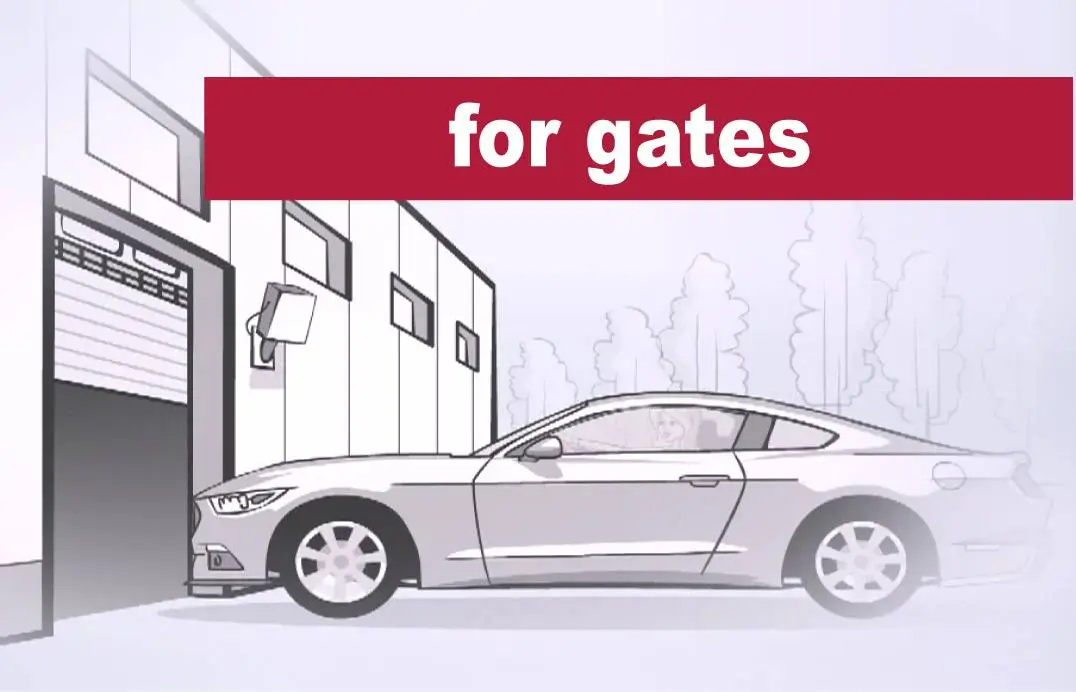
UHF means ultra-high frequency. A long-range reader near the approach lane detects a compatible RFID windshield tag, sends its identifier to access control and opens the gate only when that credential is authorized for the lane and schedule.
Many windshield credentials are passive: they contain no battery and are energized by the reader. Each tag is individually managed, so a lost, sold or unreturned tag can be cancelled without replacing every resident's remote.
How hands-free parkade entry works
- The vehicle enters the designed read zone
- The UHF reader receives the tag identifier
- Access control checks the credential, lane and schedule
- The controller sends an open command to the gate operator
- Presence and safety devices supervise gate movement
- The credential event is recorded for authorized review
Controlled read range matters more than maximum range
A manufacturer may publish a maximum read distance under ideal conditions. The real design goal is reliable lane-specific identification. An oversized zone can detect a vehicle on the street, an adjacent lane, a visitor position or the exit path.
We tune reader location, height, antenna angle, power, timing and tag position onsite. CDVI's North American UHF products, for example, include 902-928 MHz readers with published ranges up to approximately 20 or 33 feet depending on the model; the commissioned site range may intentionally be shorter.
Windshields, metal and tag placement
Metalized or heated windshields, tint, embedded wires, vehicle shape, nearby metal and tag orientation can reduce performance. A consistent approved tag position improves results. We test representative vehicles before final rollout.
Exterior, headlamp, hang-tag or hard-tag credentials may be considered when a windshield is unsuitable. Tamper-evident stickers help discourage movement between vehicles but do not identify the driver.
UHF, remotes, app access and fobs can coexist
A building can use UHF stickers for routine resident vehicles while retaining approved secure remotes for motorcycles, rentals or special cases. Mobile gate release can support authorized management or residents. Pedestrian entrances can continue using BLE, NFC, Apple Wallet, fobs or app credentials from the same access plan.
If legacy fixed-code remotes are vulnerable or impossible to audit, the transition plan should replace them with rolling-code, encrypted or individually managed credentials rather than carrying the weakness forward.
Visitor access through video intercom
A visitor can call the resident from a gate video intercom, provide live video and two-way audio, and receive an approved gate release. The same resident directory can serve the building entrance and gate when the project architecture supports it.
Temporary QR or PIN access can help scheduled guests or contractors, but vehicle routes and pedestrian doors should be limited to what the visit requires.
Free exit, loops, radar and gate safety
Outbound vehicles may use an inductive loop, radar or other free-exit detector to request opening. Photo eyes, safety edges, presence loops and operator safety inputs protect the gate movement and are separate from the access credential.
A reader or controller upgrade must not bypass gate safety. We coordinate mechanical operator, track, spring and safety work with a qualified gate contractor when it falls outside the security-control scope.
UHF is not licence-plate recognition
UHF reads a managed RFID credential. LPR or ANPR uses a camera and analytics to read a plate. UHF is normally faster and more predictable for an enrolled resident vehicle; LPR can remove the need for a physical tag but requires suitable imaging, clean plates, policy and exception handling.
Some properties use both: UHF makes the access decision while CCTV or LPR provides vehicle context for authorized investigation.
Upgrade the controls without replacing the gate
The mechanical gate and operator can often remain while the receiver, credential and access-control layer changes. We inspect the operator interface, receiver, remotes, safety devices, free-exit detection, cable, power, network and available enclosures.
WeTech has completed Lower Mainland projects that combine video intercom, gate control and long-range UHF access while retaining suitable existing remotes during the transition.
Systems and brands
Equipment selected for the project
We install, integrate or assess CDVI U4GO, Nedap Identification Systems, HID, TagMaster, Farpointe Data, AWID, TransCore, LiftMaster, DoorKing, Linear, Nice, FAAC, Viking Access, BEA, OPTEX, SecuraKey, Kantech, Keyscan, ICT, RBH and compatible Wiegand or OSDP systems.