Complete service guide
What property owners and managers should know
Upgrade comparison
| Building need | Traditional audio system | Modern video configuration |
|---|
| Visitor verification | Voice only | Live entrance video and two-way audio |
|---|
| Where residents answer | In-suite station or one telephone path | Up to four app users, plus configured telephone or indoor options |
|---|
| Resident entry | Key or separate fob system | Fob, app, BLE, NFC, wallet and other approved credentials |
|---|
| Guest access | Resident answers each call | Live call plus time-limited QR or PIN where approved |
|---|
| Management | Manual directory and separate databases | Role-based resident, directory and credential administration |
|---|
| Retrofit impact | Dependent on existing suite hardware | Mobile-first design can reduce work inside suites |
|---|
A large 10-inch entrance station built for multi-tenant use
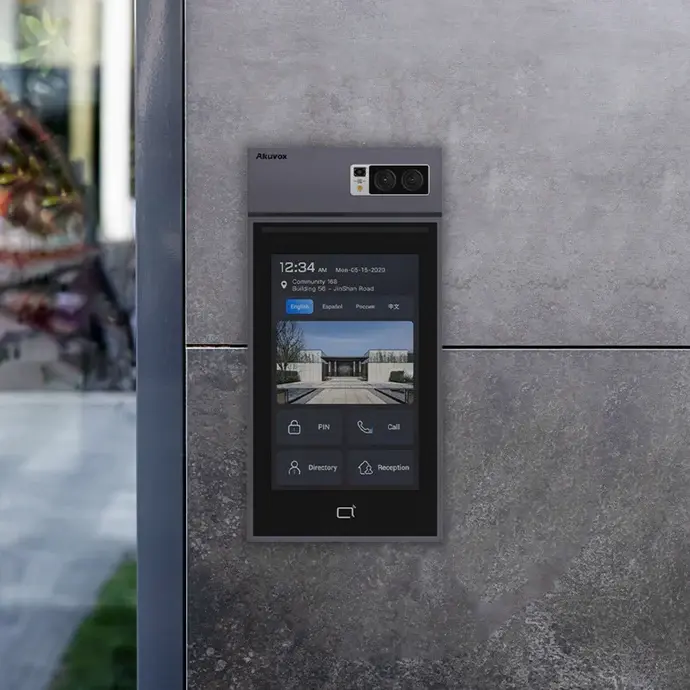
The flagship entrance station uses a 10-inch Android touchscreen, durable aluminum front, multi-camera design, HDR and low-light imaging, two-way audio and multiple door-control interfaces. Its dual-camera design supports anti-spoofing for configured face access, while a dedicated camera makes QR-code presentation easier.
The directory can be organized for apartments, businesses or mixed-use occupants. Visitors can search or browse the approved directory and call the correct unit without exposing more personal information than the building chooses to publish. The station supports SIP video communication and ONVIF integration on compatible designs.
How does a resident receive a visitor call?
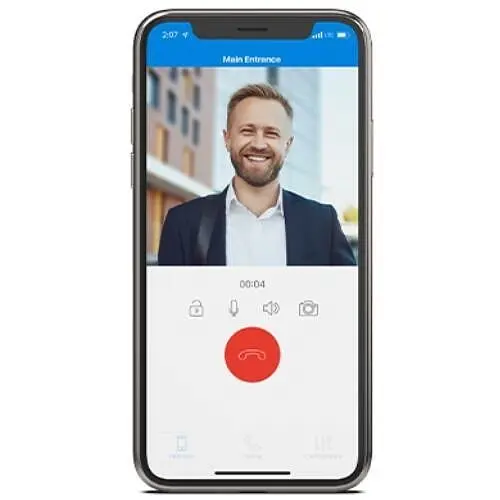
A visitor selects the resident or business. The system starts a live video and two-way audio call to the configured app users, indoor monitors or telephone path. The resident verifies the visitor and releases only the authorized entrance. The call can reach residents whether they are inside the suite or away from the property, provided the required services and internet connections are available.
WeTech's standard community setup provides up to four app users per unit. Group calling can ring the family's enabled apps and indoor monitors together; sequence calling can follow an approved order. The exact workflow is confirmed during commissioning so residents know what will ring first and what happens when nobody answers.
Telephone and landline backup for residents without smartphones
A mobile-first building does not need to exclude seniors or residents who prefer a telephone. WeTech's standard residential configuration supports up to four telephone or mobile numbers per unit when the optional calling path is enabled, with app-first or phone-backup workflows confirmed during setup.
The resident answers the voice call and uses the approved keypad command to release the door. Indoor video monitors and RFID fobs are additional alternatives. Telephone service is configuration-dependent, so it is identified separately in the proposal.
More than 15 possible access methods on one platform
Not every building should enable every credential. We select a practical combination that matches privacy, administration, accessibility and resident preference. Physical fobs can remain available even when the property adds mobile or wallet access.
- Mobile-app unlock from the resident's phone
- Bluetooth Low Energy (BLE) access, including supported hands-free modes
- NFC tap credential
- RFID fob or card backup
- Apple Wallet credential on a compatible iPhone or Apple Watch
- Secure PIN where building policy permits
- Time-limited QR code for a guest, cleaner, contractor or delivery
- Time-limited PIN on supported configurations
- Consent-based facial recognition after a privacy review
- Two-factor combinations for selected higher-security doors
- Indoor monitor door release
- Telephone-call door release
- Property-manager or concierge release through authorized tools
- Approved voice-assistant or phone-automation workflows
- Integration to a separate access-control credential ecosystem
Temporary access for guests, contractors and deliveries
Residents or authorized management can create a temporary QR code or PIN with an approved start time, end time, permitted door and number of uses. The credential can be sent to a visitor without handing out a permanent fob. This is useful for family, cleaners, caregivers, scheduled trades and short-term operational access.
Temporary access should follow building policy. A delivery person normally needs the entrance and parcel route—not unrestricted building access. Event records can help management investigate use, but a credential event does not by itself prove who physically used a shared code.
Easy management for strata council and rental managers
Authorized administrators can manage buildings, apartments, resident accounts, directory information, credentials, calling preferences and selected event information through a web portal or property-management app. A move-out can be removed without changing access for every resident; a new occupant can be enrolled; a lost phone or fob can be disabled; and temporary credentials can expire automatically.
Role-based administration matters. A rental manager may need control of assigned units while council or a property manager retains broader system authority. We document the approved roles, train administrators and recommend a move-in and move-out checklist so directory and credential records stay current.
Intercom plus access control: two systems working as one
The entrance station can manage visitor calling and also act as a credential reader for residents. When the building no longer wants shared-entry keys, integrated access control can operate the entrance, side doors, parkade lobbies, amenities, gates and elevator readers from the same resident record.
This does not mean one device should control every security function by itself. Door controllers, power supplies, locking hardware, door contacts, request-to-exit devices and life-safety interfaces are designed as part of the complete opening.
Elevator, gate and automatic-door integration
After a resident approves a visitor, a compatible system can unlock the entrance and temporarily enable an authorized elevator floor. Resident credentials can also carry their own floor permissions. Gate intercom calls can use the same resident directory, and an automatic door operator can open after the lock releases for an accessible entry sequence.
Elevator work is coordinated with the elevator contractor, and automatic-door sequencing is tested with the lock, closer, activation device and safety sensors. Integration is only promised after the existing equipment and interfaces are reviewed.
Retrofit an occupied building without entering every suite
A mobile-first design can eliminate the need for a new station inside every apartment, reducing suite access and disruption. Existing intercom cable or pathways may still be useful for network, power or selected devices, but they are tested rather than assumed reusable.
Cloud video calling needs reliable internet. Backup planning may include UPS power for the intercom, network, access controller and lock power supply. We document which functions depend on the internet, which continue locally and how management handles a service interruption.
Video-intercom privacy and resident adoption
The property should define directory data, call snapshots or recordings, retention, administrator access and optional biometric use. Facial recognition should be opt-in only after a specific privacy review and should never be presented as mandatory when fob, app, NFC or other reasonable credentials can meet the need.
WeTech supports strata councils with clear pre-installation explanations, resident onboarding, administrator training and documented fallback options. That transition work is especially important in large occupied buildings.
What affects intercom cost and installation time?
Cost and scheduling depend on the number of entrances and units, existing wiring, door hardware, network and power work, calling methods, elevator or gate integration, resident onboarding and the amount of after-hours coordination required. A single-entrance building and a multi-building community should not be compared using one generic per-unit number.
The proposal should state the selected ownership model, any recurring services, the expected cutover sequence and what residents need before launch. WeTech's standard configuration is quoted as a one-time system project without a separate monthly building cloud fee; optional telephone or third-party services are identified separately when required.
Systems and brands
Equipment selected for the project
WeTech's primary multi-tenant offering is the modern 10-inch video-intercom configuration described above. We can also assess, service, replace or migrate systems involving Aiphone, Mircom, Enterphone/Viscount, SES, DoorKing, Sentex, Linear, LiftMaster, Viking, ButterflyMX, 2N, Comelit, Fermax, DoorBird, Hikvision, Dahua and other SIP, telephone-entry or multi-tenant platforms.