
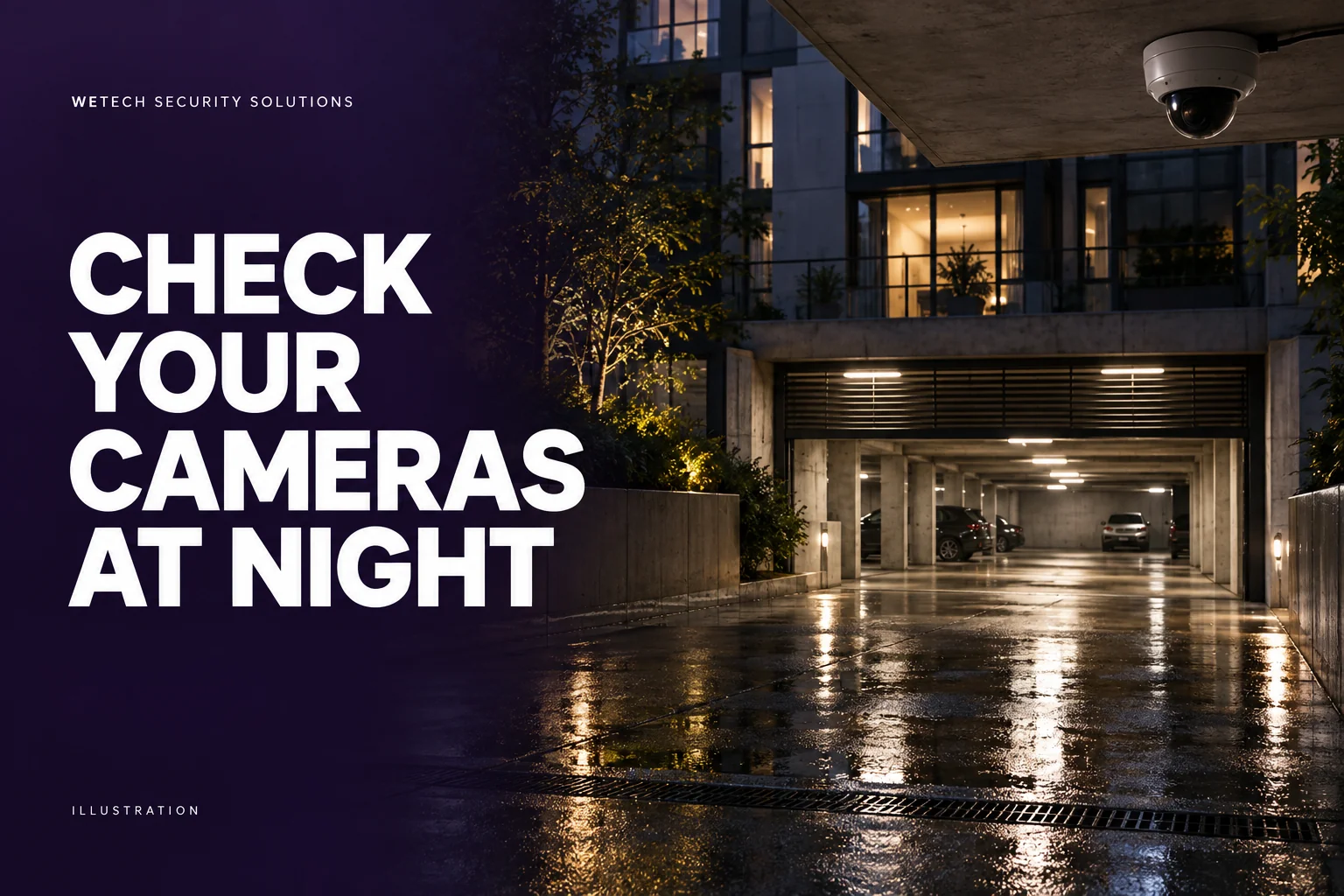
A strata council reviewing a camera proposal needs a more useful question than how many megapixels it includes: what will management actually be able to see at the front entrance or parkade after dark?
For Vancouver and Lower Mainland buildings, a sensible CCTV upgrade starts with the installed system and the conditions at each camera. This guide explains how to commission that assessment and compare the findings. It describes a test method, not a claim that a particular camera or building has already passed it.
Direct answer
The short answer
Test a recorded, moving subject at the location and time that matter to your building. A bright live picture, a 4K label or an empty parkade view does not prove that the system will capture the detail needed during an incident. Define the required view, review an exported clip, then have the camera, lighting, placement and recording settings assessed before deciding what to replace.
Start with the detail each camera needs to capture
Write one purpose beside each important camera. An overview of a parkade, a closer view of a person using a pedestrian door and a vehicle-plate view are different tasks. A single wide scene should not automatically be accepted as satisfying all three.
Axis's pixel-density guidance explains why the amount of detail on the subject matters, alongside lighting, optics and compression. Its planning model is not an identification guarantee. Ask the installer to demonstrate the specified outcome at the actual point of interest rather than relying only on a datasheet distance.
| Location | Example purpose to agree | What to review |
|---|---|---|
| Parkade overview | Understand the direction and sequence of movement | A continuous recorded event through the relevant area |
| Pedestrian entrance | See useful detail as a person enters | Movement through the intended capture position |
| Vehicle entrance | Document a vehicle or an agreed plate-reading task | The required vehicle movement and lighting conditions |
| Lobby transition | Follow an event between relevant cameras | Coverage, matching timestamps and practical playback |
Why security cameras can look sharp until someone moves
Exposure time is one reason security cameras become blurry at night. A slow shutter can brighten a still scene while smearing a moving subject. Increasing gain can brighten an image while also increasing noise. Axis's troubleshooting guidance recommends checking the camera under the expected lighting and movement, not judging an empty night scene alone.
Glare and infrared reflections are separate issues. Nearby reflective surfaces, dirt or water on a dome can interfere with the image. Record what you observe and let the service technician determine the cause; a hazy picture is not proof that the camera itself needs replacement.
A night-time camera test council can request
Arrange a controlled test with management's authorization and a consenting participant. Choose an appropriate time, keep people clear of moving gates and vehicles, and use only the views relevant to the building's approved purpose. Avoid collecting unrelated resident footage for a marketing example.
The following is a suggested assessment workflow. Agree the scope with the service company; the aim is a repeatable record that makes a proposed repair or upgrade easier to assess.
- List the selected cameras, their locations and the intended purpose of each view. Record the model, lens setting where available and the date of the assessment.
- Choose a clear test point and movement route. Note the approximate subject distance and the lighting conditions, including whether entrance lighting or headlights are present.
- Have the participant move through the agreed view at a representative pace. Include the direction that matters to the proposed purpose rather than having the person pose beside the camera.
- Find the event in playback. Record the time and the selected recording stream so the same event can be located again.
- Export the clip to an authorized device and open the exported file. Check what is visible there, not only in the live app or a phone photograph of a monitor.
- Write down the observed limitation in ordinary language. If an adjustment or replacement is proposed, repeat the same test and record what changed.
Use a findings sheet instead of a vague good-or-bad verdict
A useful report separates the observation from the proposed explanation. For example, 'the participant's movement is visible but facial detail cannot be assessed in the exported clip' records an outcome. 'The camera is defective' is a diagnosis that requires supporting checks.
Ask for the original test clip to be retained under the agreed handling process, alongside the findings. If images will be shared with council, use the approved recipients and storage method. The table below is a blank assessment structure, not a completed WeTech test.
| Record | What the assessment should contain |
|---|---|
| Purpose and test point | What the view is intended to show, and where |
| Conditions | Date, time, lighting, movement and relevant equipment settings |
| Observed result | What can and cannot be seen in the exported recording |
| Proposed action | Investigation, maintenance, adjustment or replacement, with reasons |
| Retest | The same task after the agreed work, with remaining limitations |
| Responsibility | Who accepts the result, maintains the view and handles footage |
Repair, improve one view, or replace the system?
Request three separate scopes where appropriate: maintenance of the existing view, a targeted improvement at the weak location, and a broader system upgrade. Each should state its assumptions, retained equipment, exclusions and the acceptance task it is intended to satisfy.
For example, an illustrative council decision might compare servicing two entrance views with replacing every camera. The smaller scope is worthwhile only if it meets the agreed requirement and leaves a supportable system. Conversely, preserving old equipment is not good value if the important views remain unsuitable or the system cannot be maintained.
A CCTV replacement proposal should also identify any recorder, network, power, cable, licensing or storage work. Avoid comparing a camera-only price with a proposal that includes the rest of the recording system. The written scope is more useful than a universal per-camera price.
- Ask which existing components were inspected and which were assumed to be usable.
- Identify the specific views the proposed work will improve.
- Require the agreed test and handover to be included in the scope.
- Keep unresolved conditions visible so council can compare proposals fairly.
Existing cabling may remain, but reuse needs evidence
A night-image problem does not itself answer whether the building must be rewired. Some IP-camera migrations can use suitable existing coax with compatible equipment. Axis's PoE-over-coax documentation conditions the application on the cable and power requirements; it is not a promise that any old cable will work.
WeTech's documented Mint project in Surrey describes an Avigilon IP-camera retrofit using existing coaxial infrastructure. It is a useful example of a retained-infrastructure approach. It does not establish the night-time identification performance of your building or mean that the same design fits every strata.
For a Vancouver condo CCTV upgrade, ask the assessor to record the existing cable routes and the basis for retaining or replacing them. That makes the proposal easier to review and reduces reliance on assumptions about an unseen building.
Keep image quality, recording health and privacy together
Once a view meets its purpose, the property team still needs to find, play and export the relevant recording. Use the separate WeTech recording-health checklist for storage, playback and time checks; use the CCTV privacy guide when reviewing purpose, access and handling. This article focuses on the detail visible in the image.
Add the camera assessment to the handover record. Assign someone to report a moved camera, changed lighting or a failed export, and agree when important views will be checked again. A clearly documented limitation is more useful than an unqualified statement that the building has night vision.
Frequently asked questions
Questions property teams ask
Will a 4K camera identify someone in a dark parkade?+
Resolution alone cannot establish that result. The subject must have sufficient useful detail in the recorded image under the actual conditions. Specify the task and test it at the intended position with representative movement.
Should we replace every camera if two views are poor?+
Ask for a targeted scope and a system-wide scope, with the reasons for each. The decision should consider the weak views, the condition and supportability of retained equipment, and the recording system as a whole.
Is a night test the same as a facial-recognition system?+
No. This guide concerns a person reviewing useful recorded detail. It does not propose identifying residents with facial-recognition analytics or establish that any analytics system is appropriate for the building.
Can the same camera provide an overview and read licence plates?+
Treat them as separate requirements that need validation. Ask the designer to demonstrate each intended task rather than assuming a wide parkade overview also satisfies a plate-reading requirement.
Can we keep our old CCTV wiring during an upgrade?+
Sometimes. The cable, route, distance, power and chosen equipment need assessment. A documented retrofit elsewhere is an example of what can be possible, not proof of compatibility at your property.
What should we send when requesting a CCTV assessment?+
Send the building's municipality, approximate camera count, known camera/recorder models and a description of the views you want assessed. Arrange footage sharing privately with authorized recipients rather than posting resident footage publicly.
Sources & further reading
Primary references
Want a clear assessment of your strata camera views?
WeTech Security Solutions assesses CCTV installations and upgrades for strata, apartment and commercial properties in Vancouver and the Lower Mainland. Share the existing system and the views that concern you so we can define a practical site-assessment scope.
Request a Site Visit